Opening Golf to the World
Rules of Golf
Team Match Play - Rules Spotlight

21 Sep 26
4 mins
Team Match Play - Rules Spotlight
The Walker Cup and Solheim Cup are biennial matches played at the highest levels of the amateur and professional games. The Walker Cup sees the best male amateur golfers from the United States of America and Great Britain and Ireland compete against one another, and the Solheim Cup is played between the leading female professional golfers from the USA and Europe. Following two remarkable and thrilling matches at Lahinch in Ireland and Bernardus Golf in the Netherlands, we look back at some of the most interesting rulings from the matches.The Importance of Concessions in Match Play
One of the key differences between match play and stroke play is that a player does not need to hole out if their opponent concedes the next stroke or concedes the hole in match play. However, this can occasionally lead to players lifting their ball up before their opponent has conceded their next stroke. When that happens, and a player lifts or moves their ball before it has been holed or conceded, they incur a one-stroke penalty under Rule 9.4b for lifting or moving their ball in play. This was exactly what happened in one of the morning foursomes matches on the opening day of the 51st Walker Cup at Lahinch. On the 9th hole, Niall Sheils Donegan watched his six-foot birdie putt run past the hole. Frustrated by the miss, he immediately pulled the ball back to his feet with his putter, intending to try the putt again. Sheils Donegan immediately realised what he had done and acknowledged this with the referee. As neither of the USA players had made a verbal statement or physical gesture indicating that the next stroke had been conceded, a one-stroke penalty applied automatically. The penalty meant that the GB&I side could no longer match the USA team’s score of 4 on the hole, resulting in the loss of the hole. Fortunately for Sheils Donegan, the momentary lapse in concentration did not prove too costly as he and Josh Hill went on to win their match 4&3.Klondyke
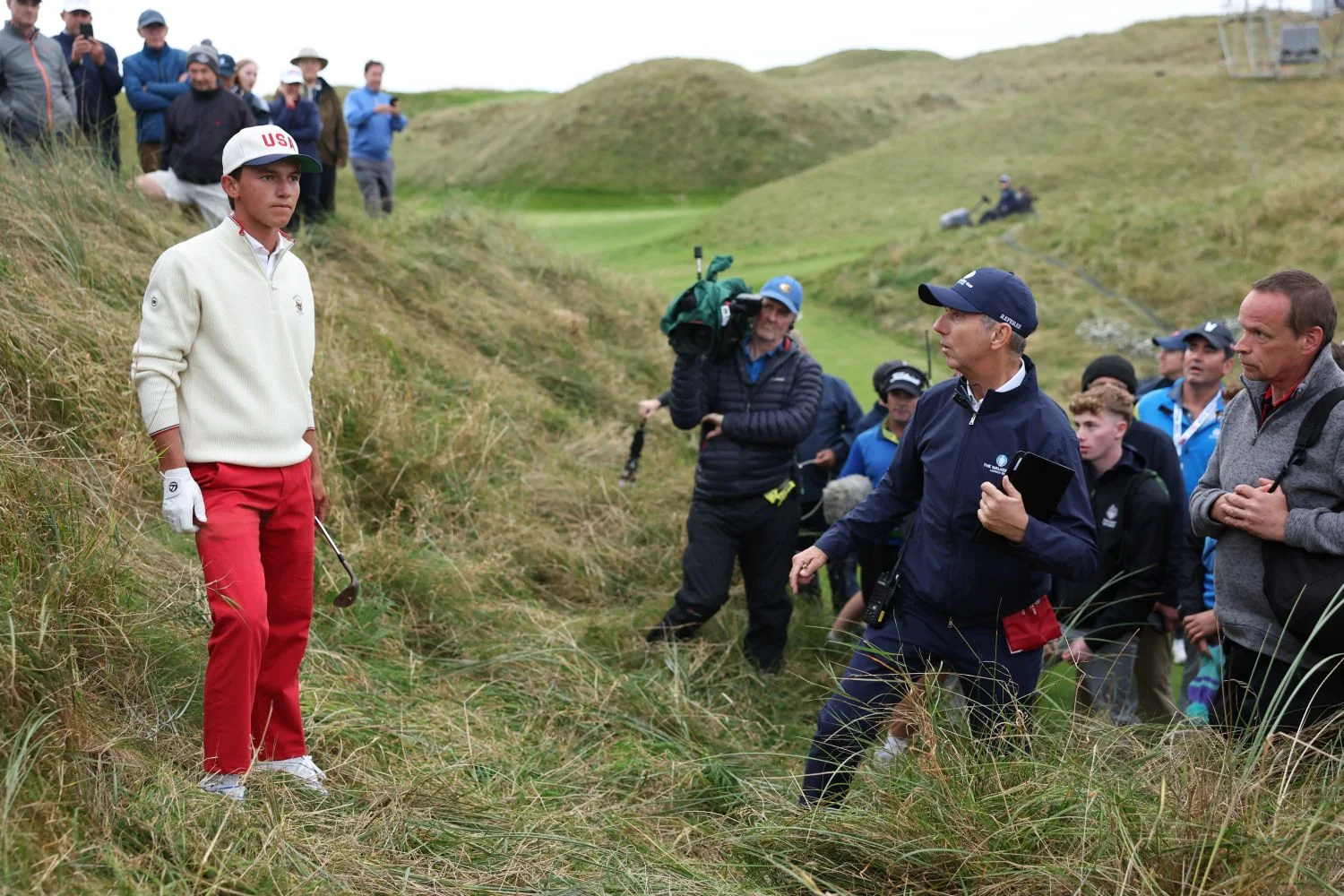
The best-known feature of Lahinch’s 4th hole is Klondyke, the large hill that makes for a blind second shot. One of the more subtle features of the hole is the much smaller two foot grassy mound which slopes up and onto the boundary wall and can occasionally act as a backstop for approach shots. In Sunday’s singles, Tyler Watts’ second shot into the green flew straight into the mound and became embedded near the top. Watts was entitled to take free relief for an embedded ball (Rule 16.3), but the nearest point of complete relief was even further up the slope and the resulting one club-length relief area required him to drop the ball on top of the mound itself. Unsurprisingly, when the ball was dropped, it rolled down the slope and outside the relief area, with the second drop producing the same result. After the two drops, the player was then required to place the ball on the spot where the ball first struck the ground on the second drop. However, this did not solve the problem as when the ball was placed, it would not stay at rest on the spot. The referee then instructed Watts to place the ball on the same spot for a second time. When the ball again failed to remain at rest, Rule 14.2e requires the player to find the nearest spot where the ball would stay at rest in the general area but no nearer the hole. This resulted in Watts placing the ball almost right on top of the mound. Faced with a precarious stance on top of the boundary wall, Watts was unable to get up and down for birdie and ultimately halved the hole with Josh Hill. The match between Watts and Hill went all the way to the 18th green, where Hill produced a superb up-and-down from the front bunker to secure a one-hole victory and, with it, the winning point in a thrilling Walker Cup triumph for Great Britain and Ireland, their first success in the match since 2015.Deciding What Caused a Ball to Move
One of the toughest rulings for a referee is determining what has caused a ball at rest to move. Such a situation arose during Sunday’s Walker Cup foursomes match between Jay Leng Jnr and Kihei Akina of the United States of America and Luke Poulter and Sam Easterbrook of Great Britain and Ireland. Easterbrook’s second shot on the 12th hole came to rest in a precarious lie in wispy rough above the greenside bunker. As the players waited for the USA side to play, Poulter stood nearby in the bunker. Moments later, the ball suddenly fell from the grass and rolled into the bunker. While Poulter had previously been relatively close to the ball with his club to assess his shot, he advised the referee that he had been careful not to touch the grass around the ball due to the precariousness of the lie. The key question for the referee was whether there was knowledge or virtually certainty (at least 95% certainty) that the player caused the ball the move. While the ball had been at rest in the grass for several minutes before it moved, it was in a precarious lie, on a slope and the wind was gusting. Although Poulter’s previous proximity to the ball was a factor that the referee had to take into account, nearly a minute had passed between him taking actions close to the ball and there was insufficient evidence to conclude that there was knowledge or virtual certainty that the player had caused the ball to move. As a result, the referee determined that the ball had moved by natural forces, rather than by the player. The ball was therefore played from its new position in the bunker without penalty.
Whose Turn Is It Anyway?
No sooner had the Walker Cup concluded than attention turned to another prestigious team match play contest. The 20th Solheim Cup saw the best female professional golfers from the United States of America take on their European counterparts at Bernardus Golf in the Netherlands. One rules situation during the Saturday afternoon four-ball matches caused confusion among both the players and spectators and highlighted an often-overlooked aspect of match play: how the order of play is determined when players take relief. Unfortunately for the European pairing of Carlota Ciganda and Celine Boutier, both players hit their tee-shots at the par 3 15th hole into the yellow penalty area just short of the green. Given the shape of the penalty area, a dropping zone had been provided as an additional relief option, and both players elected to use it. However, the order of play is determined by where the player’s ball originally lies, or, in the case of a penalty area where they their ball is estimated to lie. It is not determined by where a player chooses to play their next stroke from. Both Lindy Duncan and Jennifer Kupcho had found the putting green with their tee shots for the United States of America , however as both the American balls were farther from the hole than the estimated location of the European balls in the penalty area, both Duncan and Kupcho were required to play before Ciganda and Boutier, despite the fact that the drop zone was around 70 yards from the hole. After the players were advised of the correct order of play, Duncan putted first. Although her ball finished only about a foot from the hole, the European players were too far away to judge whether if it was close enough for them to concede. At that point, another order-of-play Rule came into effect. In four-ball, partners may play in the order the side considers best. The American side therefore decided that Duncan would hole out for her par and, after successfully holing her putt for a three, left Kupcho with a free putt for her birdie. Kupcho narrowly missed her putt, but that left the European side needing to hole one of their shots from the dropping zone to halve the hole. Although they came close, they were unable to do so, giving the USA the win on the hole. While this Rule concerning order of play may initially seem unusual, consider it this way: the Europeans’ balls had come to rest in the penalty area, but they were not required to take relief because they could have chosen to play the ball as it lies (assuming they were playable). If either player faced a decision on whether to play from the penalty area or take relief, it is entirely appropriate that they be allowed to make that decision after the USA players had played, as the USA side was farther from the hole and therefore next to play. It would therefore be inappropriate for the order of play to change depending on whether a player chooses to take relief or not, or on where that relief is taken. For that reason, the Rules of Golf base the order of play on the ball’s original location, which provides the simplest and fairest outcome. The USA’s win on the 15th hole reduced Europe’s lead in the match to just one hole. The momentum continued to swing in favour of the United States of America and Kupcho completed the turnaround by holing remarkable putts of 90 feet and 25 feet on holes 17 and 18 to secure a one-hole victory. Although this tied the overall match score at 8-8 heading into the singles matches, Europe eventually won the Cup by winning the Sunday singles session, securing a final 15-13 victory.