
Opening Golf to the World
London Golf Club
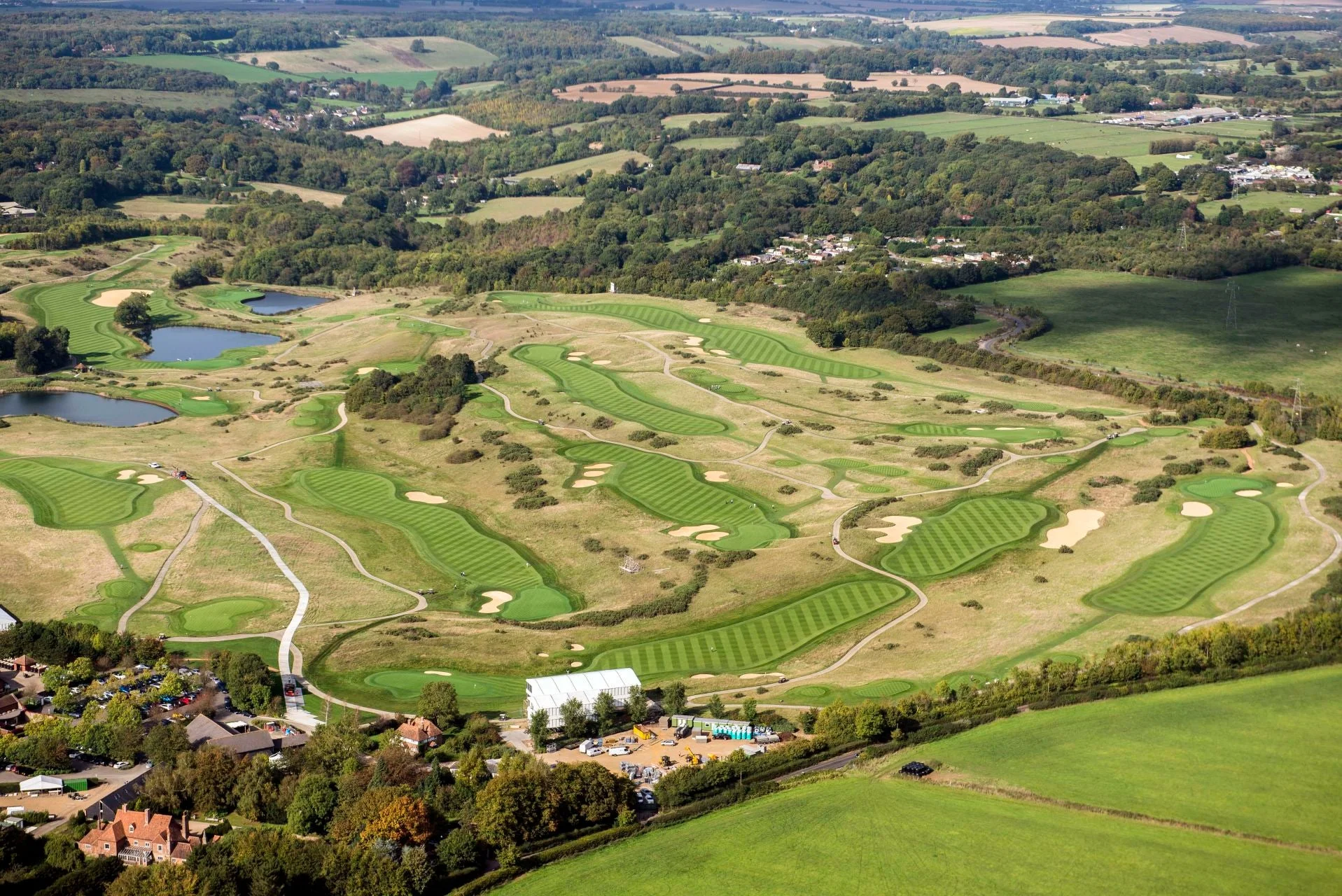
The London Golf Club was built in the 1990's. The whole golf course was designed around water harvesting, which allows the Club to harvest circa 100,000 m3 a year, enabling the Club to be entirely self sufficient for water.
The London Club was built as two 18-hole courses on existing agricultural land in the early 1990's, with a full opening in 1994. The design of the golf course was extremely innovative, with the whole design centred around water harvesting and reuse. This type of design was completely unheard of in this country in the early 90's, when such forward thinking in terms of water management was only just starting to become mainstream. The shape of the site, landscaping and all drainage works were centred around capturing and reusing water.
Approximately 400 of the 500 acre site is positively drained into a site wide catchment system. Every hollow and low point of the site has a catch basin connected to carrier pipe. These step up in size as they move through the course, with main carrier pipes ranging from to 300-600mm in diameter. Some of these are actually located nearly 3m below the surface in order to achieve sufficient falls across the site.
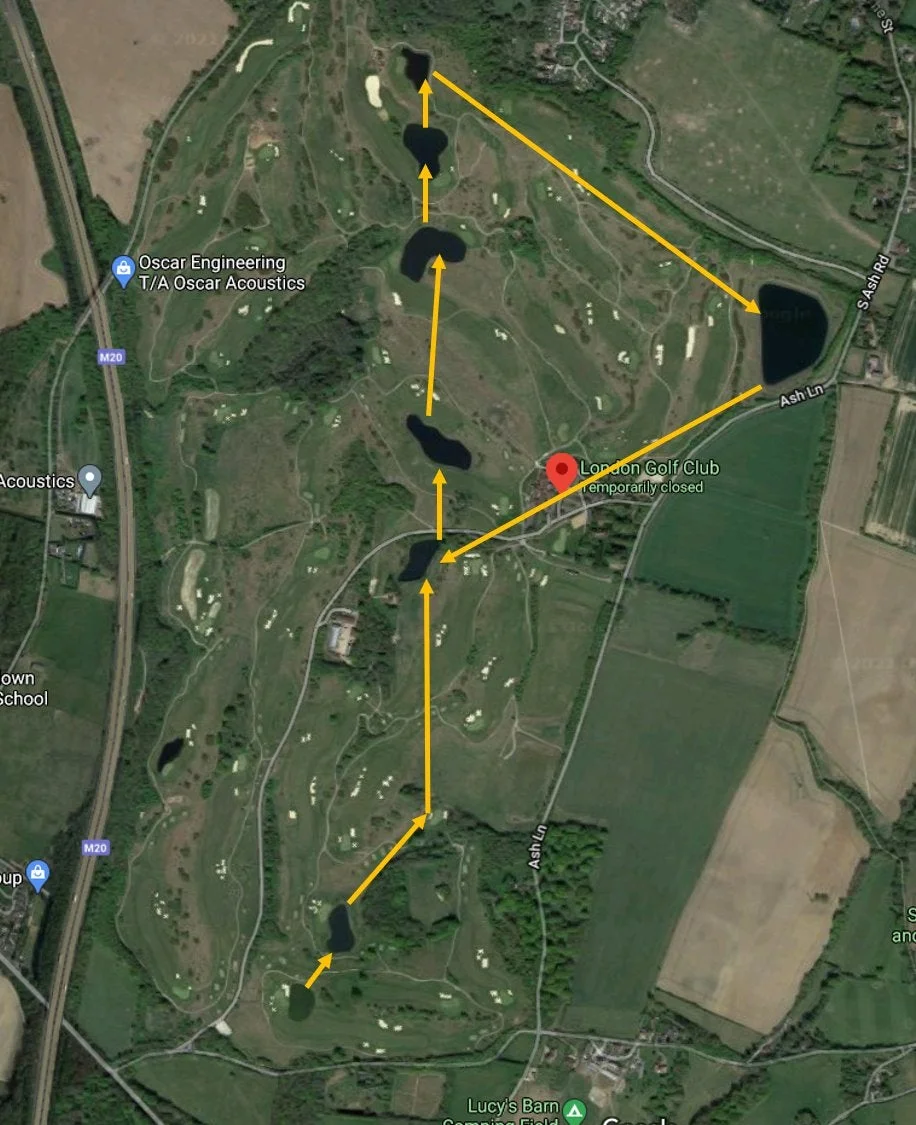
A series of eight lakes across the site act as temporary storage areas and as well as adding water features to the course. These cascade into one another to ultimately end up at the Northern end of the site. The bottom lake has two 200mm pump sets located in it, which then transfer water into the main site reservoir located at the highest pint of the site. An overflow to this bottom lake also exists in case of extremely heavy rainfall. This reservoir was originally built to hold 200,000m3 water, although it is estimated to only hold around 100,000m3 now due to silt accumulation. The map below shows the water flow between the eight lakes and reservoir.
The courses have greens, tees, fairways and some semi rough irrigation installed which usually requires 50-60,000m3 a year, although in recent dry years this has increased to 85,000m3. Therefore, the Club is fully self-sufficient for irrigation water, although does have mains back up for disaster mitigation. It is estimated that without the rainwater harvesting system the Club's annual water bill would be in the region of £90-95,000 on an average year. Therefore, the whole system has saved the Club in the region of £2-3 million (considering wholesale water price changes and inflation) since construction. The reservoir will need desilting and relining in future years which will be a significant cost. However, the system has allowed the Club to be essentially off grid in terms of water use for the last 30 years. This level of water harvesting is not really appropriate for retrofitting into existing courses, but shows the scale at which water harvesting can be implemented if enough importance is attached to it at the design stage.
Key figures
- Water demand: 50,000-60,000m3 a year (85,000m3 in recent years)
- Reservoir water capacity: 100,000m3
- Estimated mains water bill without harvesting: £90,000-95,000 a year (estimated £2-3 million saved total)
If you would like more information or advice on these water security projects implemented at the London Club, contact details are found below:
Greenkeeper Lee Sayers:-
Email: Leesayers@londongolf.co.uk