
Golf is open to all
Rules of Golf
2026 Continental Amateur Championships – LAAC, African Am and WAAP.

07 Apr 26
7 mins

Latin America Amateur Championship
The 2026 Latin America Amateur Championship was held at the historic Lima Golf Club in the heart of the capital of Peru. With towering skyscrapers bordering the course on all sides, often with their tops blurred with faint sea fog, Lima Golf Club proved a stunning setting for the 11th showing of this Championship. During the four-day Championship, any rulings required typically involved relief from artificially surfaced paths, or assistance when proceeding under Rule 17 for a ball in a penalty area and options available to the player in question. However, there were a few more unique instances which required a player calling for help from the Rules Committee. Matias Calderon, during his first round on the 11th hole, struck his tee shot on the long par-3 on a great line, but his ball came up just short of the green coming to rest on the grass bank of the greenside bunker. Calderon then walked to his ball and began to assess his next shot. While standing on the green between his ball and the hole, gravity proved too much for his ball, and it fell into the bunker. Calderon rightly called for a Referee and explained his actions leading up to the ball moving; he had looked at his next stroke from the bunker but had not taken any practice swings prior to the ball moving and testament from the player, his caddie and players in the group suggested that he had not undertaken any actions which would have caused the ball to move. Therefore, as the known or virtually certain standard was not achieved for the player causing the ball to move, he was given no penalty under Rule 9.3 and it was deemed the ball was moved by natural forces, and Calderon played the ball from its new position in the bunker. Lima Golf Club was in magnificent condition, with Bermuda grass greens running pure and true at just short of 11 on the stimpmeter. However, there were one or two queries from players raised during play relating to the condition of the holes. Bermuda grass root system grows horizontally in the upper layers of the turf, so when the hole is cut there is often crumbling on one side where roots have been damaged by the cutting process. However, this is normal with this grass type, therefore deemed natural wear of the hole under the Rules and players were not permitted to try and repair any damage in this manner (Rule 13.1c). The aforementioned sea fog did drop a little lower for the final round and resulted in a delay of an hour and 37 minutes due to poor visibility, however this lifted and led to a thrilling finale. Mateo Pulcini of Argentina and Virgilio Paz Valdes of Venezuela battled it out down the stretch with some clutch putts being exchanged between the two, eventually ending in the two being unable to be separated and leading to a sudden death play-off on hole 18. A pair of pars on the first play-off hole were recorded, but on the second play-off hole the Venezuelan caught a flyer from the rough, the ball flew the green, bounced on the cart path and eventually finished under a tree close to a number of TV cables. Chief Referee Shona McRae, Director of Rules at The R&A, was on hand to advise the player the cables were movable obstructions and that if the ball moved during removal of these cables there would be no penalty and the ball would be replaced on the original spot. With the cables safely removed from the area of intended swing, Paz Valdes impressively chipped his ball onto the green, but the shot proved too difficult. par from Pulcini was enough to secure ownership of the Latin America Amateur Championship title for 2026 and gain exemption into the 2026 Masters Tournament, US Open and The Open.
Mateo Pulcini managed an historic victory at Lima Golf Club.
Women’s Amateur Asia-Pacific Championship
The 2026 Women’s Amateur Asia-Pacific championship was held in Wellington, New Zealand. A stunning location for this prestigious championship, however the weather proved to be a genuine challenge for players and the Rules Committee throughout. Heavy rain during round two caused temporary water accumulations on most greens. However, the forecast was for conditions to improve throughout the day so a combination of squeegeeing the greens, where water can be pushed from the putting green surface using a large roller, and the provisions of Rule 16.1 with free relief available for players from this abnormal course condition for physical interference and line of play when their ball is on the putting green, ensured play could continue. Thankfully, this ensured play was able to conclude as scheduled and not direct affect the rest of the championship. Mother nature was not done there; there were also strong winds during the final round, with gusts reaching as much as 60 mph at times! However advanced forecasting helped the Rules team on the ground change the plans for the putting greens, ensuring more grass was present and more sheltered hole locations deployed leading to balls at rest not being moved frequently by the winds. Under the Rules and the changes made in 2019, a ball which has been marked, lifted and replaced on the putting green when moved by wind is replaced on its original spot. However, if the marking, lifting and replacing process has not occurred and a ball is moved by natural forces, the player must play the ball from its new spot. So, ensuring fewer balls at rest were being moved by the strong winds helped ensure that playable conditions were maintained. With players travelling from all over the Asia-Pacific region to compete, taking steps to ensure the championship could be played in its intended format and duration was well received by all!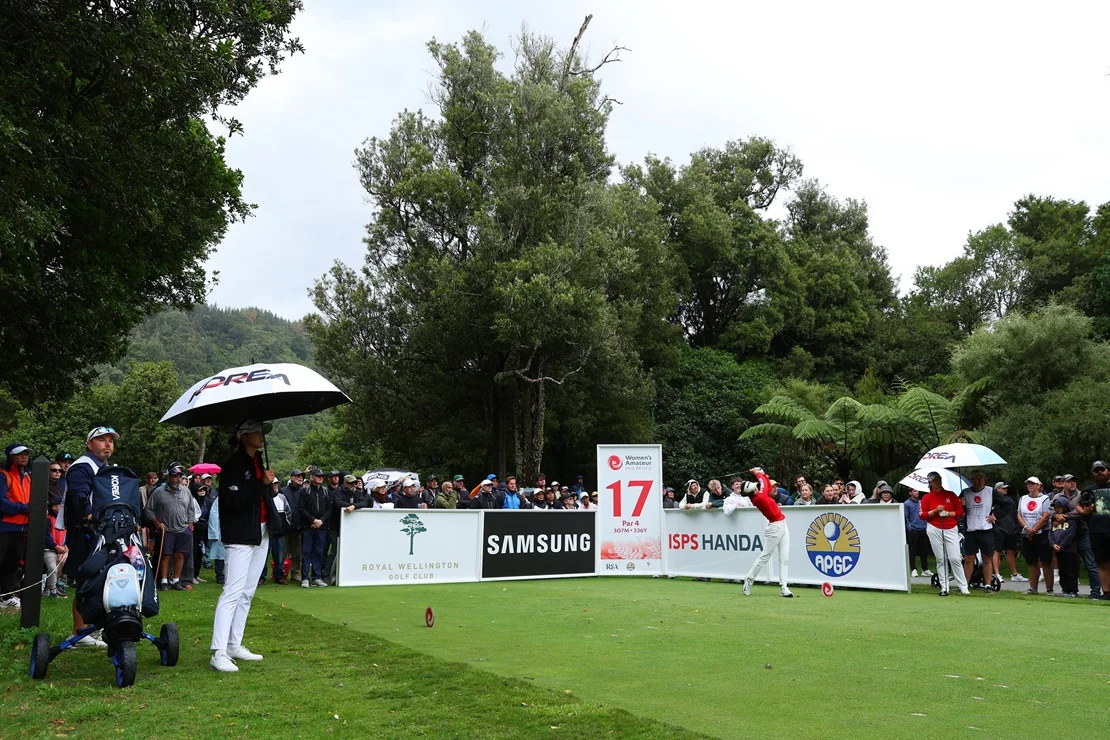
Soomin Oh of South Korea tees off on day four of the The Women's Amateur Asia-Pacific Championship
African Amateur Championship
The third staging of the Africa Amateur Championship was held at Royal Johannesburg Golf Club in South Africa. At the same time as the men’s Championship took place, the Africa Amateur Women’s Invitational was also staged at the same venue. From a course set up perspective, this meant greater and more methodical thought was given to hole locations for the week to ensure a fair test was encountered by all players considering the differing ball flights that would be attacking the greens. The second aspect that had to be factored in was altitude! The course sat at just over 1600 metres above sea level which meant the ball would typically fly much further once in the air. The course was presented in immaculate condition with only a few small areas of ground under repair to be marked. There were, however, no shortage of penalty areas on the lower section of the course that weaved alongside and between holes. The irregular shape of the penalty areas made it difficult on occasions to determine where a player’s ball may have last crossed the edge of the penalty area. One ruling in particular involved the leader, and eventual winner Jack Buchanan, on the 15th hole during round four. The 15th had a red penalty area running the length of the hole on the left-hand side with it jutting out and encroaching closer to play near the green. Playing his approach to the green from the right rough, Jack hit his ball towards the middle of the green, but it started turning hard left during its flight and finished in the penalty area. Now to determine where his ball last crossed, TV footage was inconclusive. However, thanks to the help of a greenside ball-spotter, we knew it didn’t land outside the penalty area before bouncing into the water. It landed straight in which meant it did not cross right next to the green. As mentioned, the shape of the penalty area meant that it was important to determine where it last crossed the edge as this could result in a significant benefit to the player… dropping nearer or in fact further from the green. Unfortunately for Jack, his view had been obscured by the trees in front of him as he made the stroke, but he did know the ball was turning a lot in the air. We used this evidence, along with the fact it had not crossed the penalty area next to the green, to work backwards and identify where the ball was most likely to have crossed. Jack suggested his ball had crossed next to where it had come to rest because of its flight, but with the shape of the penalty area this was not possible unless it crossed at 90 degrees. His playing partners were asked if they had any information, but it was inconclusive, therefore we made a reasonable judgement on where the ball last crossed. There was disagreement between the Chief Referee and Jack on the location of the reference point but after discussion a decision was made that resulted in a lateral relief drop being taken approximately ten yards from the green rather than two. One other ruling of note was during round three, when a player arrived late to the tee. The player argued that he was present when his name was announced, as he was the third player to tee off. Even though the player did arrive when his name was announced and it was his turn to play, the player avoided being disqualified as he arrived no more than five minutes late. Instead, the player got two penalty strokes (general penalty) applied to his first hole as the exception to Rule 5.3a applied. The Rules require players to be ready to play at their starting point and starting time, not when it is their turn to play!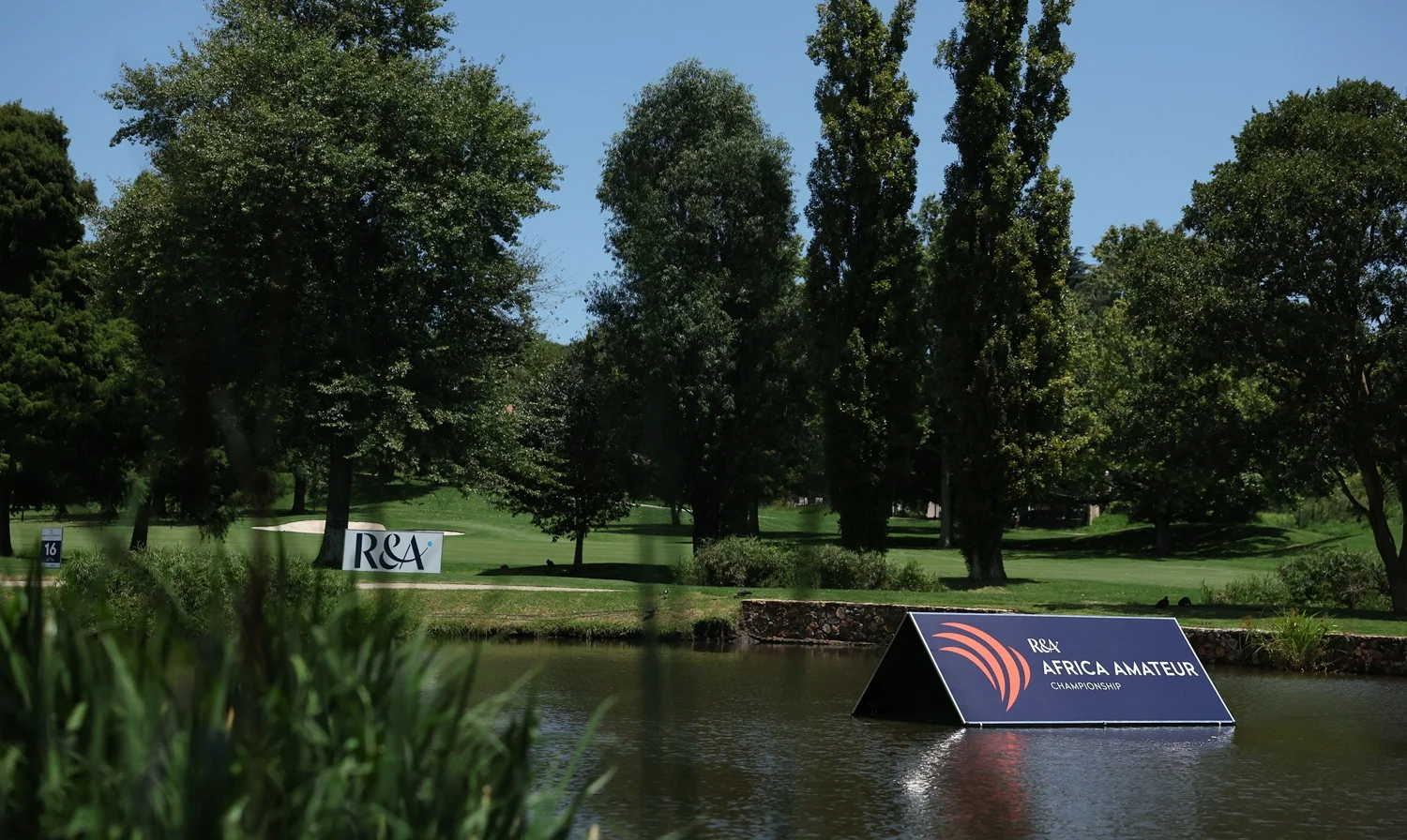
Africa Amateur Championship at Royal Johannesburg